
Venue
Update & Visitor Guide
Visitor Guide: What to see, Do and Discover
03 Dec 2025
The Next Chapter of Chiang Mai Design Week
A Talk with the Director of CEA Northern Regional OfficeThe Next Chapter of Chiang Mai Design WeekStepping into the Next Era of Collaboration, Creativity, and GrowthIn the early morning in Chiang Mai, sunlight filters through the trees lining the old city moat. Red Songthaews slowly pass through Tha Phae Gate, while the aroma of coffee from local cafés mixes with the sound of bicycles along narrow lanes. People gradually step out from their accommodations, beginning a new day in a city they know so well. While these scenes may seem ordinary, they reflect the city’s “unstoppable energy and vibrancy.”Over the past decade, the dynamic spirit of Chiang Mai has been showcased through Chiang Mai Design Week (CMDW). More than just an annual design festival, CMDW has become a platform reflecting the lifestyles, creativity, and thinking of its people. Born from the belief that creativity can drive a city, the festival has grown from a small event in the Old City to an internationally recognized festival, attracting participants from Asia, Australia, and Europe, particularly in craft, design, music, and art sectors. Stepping into “The Next Chapter” is reflected in economic impact, with a total value of 5.7 billion THB generated over the past 10 years, alongside a steadily increasing number of both domestic and international participants each year.“The Next Chapter” not only signifies the continued growth and sustainable empowerment of all communities involved, but also represents a new direction — positioning CMDW as a platform to foster collaboration across Northern provinces and on the international stage.From a Decade of Ideas and Experiments to the Next Era of CollaborationMs. Imhathai Kunjina, Director of the CEA Northern Regional Office, stated that, “The first decade of CMDW has been a period of nurturing the seeds of creativity — allowing Chiang Mai to experiment, evolve, and grow. The festival has provided a platform for artists and creators to share their stories through art, supported by local communities and residents who generously opened their homes and neighborhoods for visitors to learn, explore, and co-create. It has also shown people of all ages that creativity holds real value, while inspiring many young talents to return to their hometown to pursue their passions.” “For the 11th edition, it is not only a celebration of past successes but a stepping stone for scaling local creativity and innovation toward stronger, sustainable growth. Since 2022, CMDW has followed a theme centered on the local essence: Local Rise’ation (2022), Transforming Local (2023), SCALING LOCAL (2024), and in 2025, Local Plus: Creativity, Technology, Sustainability. All these themes emphasize that local communities are ready to expand, create opportunities, and grow internationally.”“CMDW is more than just a design event; it serves as a key tool for city branding, positioning Chiang Mai as a city ‘Crafting Wellness from Local Essence, Inspiring Asia’ in the region. The festival drives this vision through three main goals: 1) Supporting the potential and networks of returning creatives (Homecoming) in collaboration with local and international creative communities; 2) Preserving sustainable local ways of living (Local Sustainable Living); and 3) Connecting Local Essence × Creativity × Technology to create new opportunities (New Opportunities), which are crucial for advancing the creative economy in Northern Thailand,” added Ms. Imhathai Kunjina.Local Plus: The Collaboration EquationCMDW2025 communicates the “Local Plus” theme through five symbols, each representing the role of different stakeholders in driving the city forward:Plus/Add (+): Uniting people, organizations, and international partners to strengthen Northern creativity.Multiply (×): Expanding local impact globally through collaboration with over 10 countries across Asia and Europe.Divide (÷): Sharing knowledge, inspiration, and creative innovations.Minus (-): Reducing limitations and environmental impact for sustainable growth.Infinity (∞): Unlimited growth for Chiang Mai as a city in constant evolution.“Local Plus” thus serves as a symbol of the equation of collaboration, reflecting the philosophy of developing a creative ecosystem powered by everyone. Whether as artists, designers, artisans, researchers, entrepreneurs, or representatives from the public and private sectors in Chiang Mai and the Northern region, each individual plays a vital role in driving the creative ecosystem forward,” Ms. Imhathai added.CMDW’s Next Chapter: From Local Roots to Global Inspiration CMDW’s Next Chapter will transform every district in the city into a unique opportunity for both community and urban development. Drawing from “local cultural roots,” the festival aims to “inspire” visitors from around the world while encouraging investment and engagement. Highlighting the richness of local crafts, materials, and traditional skills, the festival integrates holistic wellness, design, music, and Northern Thai cuisine to refresh and elevate the city’s image in line with evolving global trends. Data from Thailand’s creative industries indicate that cultural tourism generates the highest revenue, while the largest creative workforce is employed in advertising, followed by crafts and visual arts, and then design. This underscores Chiang Mai’s potential to leverage local creativity as both an economic and cultural driver on the international stage.Other noteworthy creative industries include music, which in 2025 is valued at approximately 1.8 billion THB, driven by the growth of streaming platforms and the expanding “Thai Music Wave” in international markets. Adjacent markets, such as the “fragrance industry,” have generated revenue of 391 million USD (approximately 12.6 billion THB) and are projected to reach an additional economic value of 491 million USD (around 15.9 billion THB) by 2028. Northern Thailand, in particular, holds significant potential to leverage local resources — such as diverse plants and by-products from the agricultural sector — to sustainably produce “fragrance” products. All of these developments underscore the festival’s approach as a key platform to enhance the visibility and recognition of Thailand’s creative industries and regional potential on the global stage.From Local Creativity to Global ElevationCMDW2025 spotlights the wellness industry through the concept of “Scents from Native Plants,” filling TCDC Chiang Mai with the unique aromas of the region. Highlights include the exhibition Make Scents, Make Sense, which explores “ scents” as a new cultural and economic asset of Thailand, and The Homecoming Club, featuring a Homecoming Speed Meeting that invites young artists and entrepreneurs to return home and inspire the local community.In addition, the festival continues to expand international collaborations, creating new opportunities with designers from around the world. Highlights include the International Design Showcases, a platform presenting works by global artists; the French exhibition “SEN,” which invites audiences to explore the concept of “lines” across multiple dimensions through a three-part artistic experience that deeply connects art and the body.The LABBfest.2025 international music and arts festival; and the ceramic exhibition CRAFTed of Taste: The Art of Eating, connecting Thailand and France. Further projects include the Yumeie Dream House Project by Thai and Japanese youth, and Fixing the Past, Making the Future by Studio Bora Hong from Seoul, South Korea, which opens a cross-cultural dialogue on the Cosmetic Surgery Kingdom concept and the creative use of resources in the context of sustainable local living.The festival is managed with a strong focus on sustainability. Existing pavilions and display structures from previous years are reused, while foam board signage has been replaced with recycled plastic materials. Printing is minimized, with reduced production volumes and limited sizes to cut down on waste. Additionally, within the POP Market, featuring over 140 craft brands, waste management practices are implemented and the use of single-use plastic containers is significantly reduced.All programs of CMDW2025 embody the belief that creativity is not confined to exhibition spaces — it can be found everywhere, from markets and cafés to the sounds of live music, and especially in the smiles of people coming together to bring each event to life. Through this collective energy, Chiang Mai continues to grow as a city of inspiration, thriving alongside its community.Join Chiang Mai in stepping into the Next Chapter at Chiang Mai Design Week 2025 (CMDW2025), 6 – 14 December 2025, across Klang Wiang, Chang Moi – Tha Phae, Sanpakoi, and throughout Chiang Mai.Follow for more details: Website: www.chiangmaidesignweek.com, Facebook: Chiang Mai Design Week, Instagram: Chiang Mai Design Week, TikTok: Chiang Mai Design Week#LocalPlus #ChiangMaiDesignWeek #CMDW2025 #เทศกาลงานออกแบบเชียงใหม่
24 Nov 2025
Insight LOCAL PLUS: Behind the Identity of CMDW 2025 by slowmotion
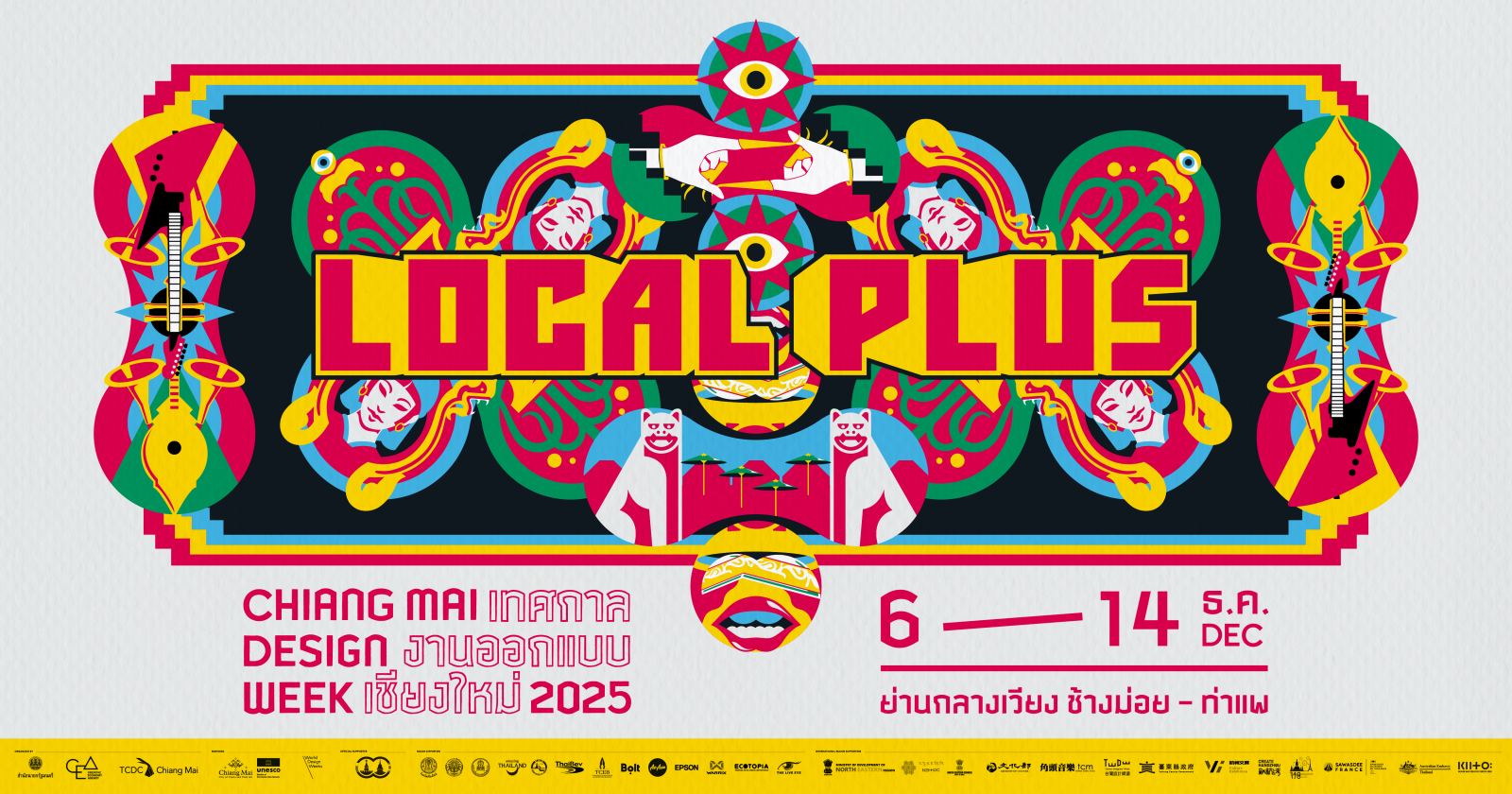
Chiang Mai Design Week 2025 embraces the theme LOCAL PLUS, celebrating the strength of Northern creativity and transforming the plus sign into a symbol of boundless collaboration and infinite possibility.To embody this spirit, the festival’s identity bursts with vivid colors and layered local references that gather in a joyful rhythm of celebration.CEA Chiang Mai spoke with Nu Nimsomboon and the slowmotion team about the creative process behind this bold visual identity, a tangible expression of LOCAL PLUS.“We began by reinterpreting what Chiang Mai is. It is not only craft or slow living. The city is alive, contemporary, and constantly blending the old with the new,” said slowmotion.That essence aligns with LOCAL PLUS, a theme that moves beyond the sign itself. The concept draws from mathematical symbols: adding value, multiplying creativity, subtracting waste and environmental impact, and dividing to share knowledge and space.This vision unfolds in a multi-dimensional logotype, as if beams of radiant color are cast forward, with Northern Thai motifs woven into the key visual.“Some elements are instantly recognizable, like hill tribes and old city walls. Others are more abstract, such as pairing the traditional fingernail dance with the energy of 70s rock guitars. It shows that Chiang Mai is not only a tradition, but also a surprise and layers of discovery,” they explained.Diversity became the central muse, a portrait of a city where heritage and modernity breathe together. The design embraces this variety through abstract, rounded forms inspired by math symbols, evolving into new creative equations for the festival.“Once we had the symbols, we asked ourselves how they might serve. Since the theme is diversity, we embedded graphic elements within each symbol to express that richness, while still echoing their mathematical roots.”For slowmotion, this diversity was both the delight and the difficulty: choosing what to hold on to, what to release, and how to make every element resonate together.“We wanted this year’s key visual to feel unlike the years before, even its opposite. Chiang Mai is not only a slow and sleepy town. So much is happening here. We wanted to capture that intensity.Beyond aesthetics, we hope this design invites people to see Chiang Mai with new eyes, both familiar and unexpected, sparking curiosity while staying rooted in the city’s unique local charm.”This is LOCAL PLUS, through the imagination of slowmotion. How do you see LOCAL PLUS? Come and discover it at Chiang Mai Design Week 2025, from December 6 to 14, across Old Town, Chang Moi, Tha Phae, and throughout the city.
01 Nov 2025
Chiang Mai on the Verge of Music
Chiang Mai Music: The Making of a Creative CityFor generations, music has been at the heart of Chiang Mai’s cultural identity. It has never been just entertainment, but a voice, a story, and a magnet drawing people into the city’s embrace. In the late 20th century, Jarun Manopetch’s iconic folk songs defined the soundscape of northern Thailand, introducing countless listeners to Chiang Mai through his tender yet powerful storytelling. Even after his passing, the city’s musical pulse never slowed. Acts like Acappella 7, HUM, ETC., POLYCAT, Solitude Is Bliss, Yonlapa, Boy Imagine, and Khian Khai & Wanich continued to shape Thailand’s soundscape, placing Chiang Mai firmly on the map as a hub of independent creativity and musical talent.Today, the city’s reputation extends beyond the stage. It has become a fertile environment for musicians and artists, supported by a unique geography and culture. Nestled between mountains, with universities, artistic communities, and a relaxed rhythm of life, Chiang Mai fosters collaboration across disciplines—where musicians, writers, and visual artists uplift one another. This climate has allowed music to evolve in eclectic ways, defying genre boxes and attracting musicians nationwide and internationally to relocate here. Chiang Mai is now not only producing artists of national and global acclaim, but also inspiring countless others to dream of making music within its creative ecosystem.Yet, challenges persist. Venues have grown, but audiences have shrunk. Local listeners often overlook Chiang Mai’s own bands until they gain fame in Bangkok, creating a paradox where outsiders embrace the city’s music more readily than its own people. As Supicha “Cha” Tesdaroons—musician, event organizer, and founder of Chiang Mai Original—observes, the missing piece is cultivating strong, loyal audiences. Without this, the city risks losing the vitality of its music community.Other voices echo this urgency. Supakarn “Eung” Warinpramot, founder of Tempo.wav, notes that while Chiang Mai has an extraordinary musical identity rooted in diversity and openness, systemic support is lacking. The tourism economy grows year by year, yet the benefits rarely trickle down to musicians, who often juggle multiple jobs just to survive. For her, music is not only a profession but a lifeline—something that heals and sustains mental health. She sees the need to build sustainable listening cultures where smaller artists can thrive.Musician and label founder Sumeth Yodkaew of Minimal Records stresses the need to rebuild community connections. A decade ago, listeners were plentiful but venues scarce; now venues are abundant, but audiences have scattered—partly due to social media and the pandemic. He envisions a Chiang Mai Music Center, a cultural hub that would gather record shops, studios, performance spaces, and archives of the city’s musical heritage under one roof, rekindling intimacy between musicians and listeners.From a festival perspective, Simona Meesaianyati and Dontri Siribanjongsak of POY Festival emphasize Chiang Mai’s openness as its greatest strength. Here, artists and audiences alike are free to experiment and cross-pollinate cultures—foreign musicians can easily join local jam sessions, tap dancers spontaneously join concerts, and every space feels welcoming. But they also point to the lack of a clear policy. International visitors are surprised to discover such rich music scenes here because they are not promoted. With strategic communication and municipal support, Chiang Mai could attract tourism centered on music itself, rather than relying solely on seasonal highs and lows.Together, these voices paint a vision: Chiang Mai is already a city of music in spirit. Its ecosystem is fertile, diverse, and resilient. But to truly become Thailand’s first official “City of Music,” it must be recognized, supported, and invested in—not only through stages and festivals, but by strengthening audiences, building cultural infrastructures, and creating policies that treat music as an economic driver. If nurtured, the city’s musical capital could become one of its strongest creative economies, enriching both cultural life and economic vitality for years to come.
26 Oct 2025
CMDW2025 Exhibitors Seminar
Chiang Mai Design Week 2025 Announces the Theme LOCAL PLUS: Empowering Creative Synergy in the North, 6–14 December 2025Chiang Mai Design Week (CMDW) is an annual festival organized by the Creative Economy Agency (Public Organization) or CEA, in collaboration with networks of creatives and entrepreneurs across Northern Thailand. The festival showcases design works and ideas that integrate innovation into everyday life, while also serving as a platform connecting regional and international collaborations. Its mission is to elevate the economy and address contemporary social and environmental challenges through creativity.In 2025, CMDW returns for its 11th edition under the theme LOCAL PLUS, creating spaces for positive thinking and fostering collaboration among people, organizations, and the public sector.Drawing inspiration from mathematical symbols, the festival positions design as a tangible driver of economic and social progress. The plus sign (+) represents collaboration. The multiplication sign (×) signifies the amplification of creative energy from local to global. The division sign (÷) symbolizes the sharing of knowledge and innovation. The subtraction sign (−) reflects the reduction of constraints and environmental impact.Together, these ideas form an equation relevant to all generations, strengthening connections across age groups through diverse creative activities.These concepts will be brought to life across Chiang Mai, from the Old Town to Chang Moi–Ratchawong Road, Tha Pae Road, and Chang Klan Road. They will also be reflected in programs presented by creative networks from across the North, spanning food, crafts, design, and music. The festival aims to achieve three core goals: celebrating returning creative talents, sustaining local ways of life, and building networks for collaboration.Highlights of CMDW2025 include exhibitions and programs that revisit the cultural and natural assets of the North through a contemporary lens, while amplifying collaboration across disciplines:– An exhibition by leading Thai perfumers who transform local resources and agricultural surplus into fragrances that reduce environmental impact and add value for farmers.– An exhibition by the food sustainability network, presenting the potential of local ingredients and collaborative practices to add value to the food industry.– LABBfest, a music festival that connects Northern artists with audiences on both regional and international stages.– Pop Market, a creative marketplace featuring products and services shaped by sustainable processes, from production to event management.– A wide range of workshops and contemporary art performances that highlight creativity as a force for change.To expand the reach of LOCAL PLUS, CMDW2025 also partners with international networks to host showcasing designers and artists from Taiwan, Austria, Uzbekistan, Japan, and other countries. The program will include workshops and exchanges that foster dialogue between local and international creatives.As a local platform evolving into a global stage for creativity and exchange, the festival takes place from 6 to 14 December 2025 across Chiang Mai’s Old Town, Chang Moi–Ratchawong Road, Tha Pae Road, and Chang Klan Road.#CMDW2025 #ChiangMaiDesignWeek #LocalPlus
12 Sep 2025
From Blue Zone to Blue Ocean: Exploring Economic Opportunities in Chiang Mai
By 2035, Thailand will become the first developing nation to enter a super-aged society, with over 30% of the population aged 60+. Some areas, like Chiang Mai, are already there.Chiang Mai—Thailand’s largest province by land area—now has 404,512 elderly residents (24.08% of its population) and 1,152 centenarians, the third highest in the country. This doesn’t include the many Western retirees who have made it their final home.While this shift poses challenges for a service-driven city, it also opens economic possibilities.Blue Zone: Where Sustainability Meets LongevityIn the early 2000s, Belgian demographer Dr. Michel Poulain and Italian epidemiologist Dr. Gianni Pes studied Barbagia, Sardinia, for its unusually high longevity. They marked it with a blue circle, leading to the term Blue Zone.Their 2004 research was later expanded with journalist Dan Buettner, resulting in the Blue Zones book (2008). The term now refers to places where people live longer, healthier lives.Six original Blue Zones include Okinawa (Japan), Sardinia (Italy), Nicoya (Costa Rica), Ikaria (Greece), Loma Linda (USA) and Singapore. Buettner also identified six key factors of longevity: (1) purposeful living, (2) eating in moderation, (3) plant-based diets, (4) strong social/family ties, (5) spiritual or religious practice, and (6) restful, low-stress lifestyles. These depend not just on habits, but on city design, access to food, healthcare, and community life.Return to Chiang Mai—where lush nature, vibrant culture, an easygoing rhythm, and nourishing local fare converge. Home to about 1,152 centenarians—the third‑highest count in Thailand—the city points to clear Blue Zone potential and presents a blue‑ocean landscape for fresh, well‑matched ventures.Ready Set OldAt Chiang Mai Design Week 2024, the “Ready Set Old” exhibition invites visitors to explore the assets and readiness of Chiang Mai across various dimensions that support a high quality of life for the elderly. At the same time, it highlights opportunities to develop the economy through careers that align with Blue Zone principles. These are presented through four key elements: access to diverse healthy foods (with potential for developing senior-focused health food businesses), daily routines that encourage natural movement (such as senior fitness trainers or wellness content creators), housing that supports multi-generational living (like holistic rehabilitation specialists or senior-friendly travel services), and a strong sense of purpose rooted in religion and cultural engagement (creating opportunities in cultural tourism and related careers).While Blue Zone and Blue Ocean share the same color, their meanings differ. The first blue refers to longevity-friendly communities, while Blue Ocean describes untapped market spaces with little competition. Yet, when we view Chiang Mai’s resources as economic potential, we can envision a new Blue Ocean driven by aging demographics.An Opportunity Still Unfulfilled? The Ready Set Old exhibition not only showcased potential careers and businesses for an aging society, but also encouraged public reflection on Chiang Mai’s existing limitations.Visitors voiced concerns over insufficient green space, air pollution, inadequate public transport, poor pedestrian infrastructure, and limited government support for senior welfare.Although various policy proposals have been put forward—by Chiang Mai University’s Lifelong Education Institute or national ministries like the Ministry of Social Development and Human Security—there has yet to be a comprehensive, implemented plan to turn Chiang Mai into an aging-friendly economy. “Actually, Chiang Mai has elderly spaces, but most are private and costly. Public ones are limited and under-promoted,” said Aunt Daeng – Narumon Klangwichian, a community leader from Phuak Taem. “Since our city is already fully aged, public activity spaces for seniors should be part of basic social welfare,” she emphasized. Similarly, Aunt Nid – Wanida Intawong, a retired government official, added: “Although community life here supports senior well-being, if the city helps us turn this into income-generating opportunities, Chiang Mai would be even more livable.” She also noted recent developments such as the Senior Wellness Center ( Chiang Mai University,) but also pointed out that access remains limited and costly. “The city needs to integrate these resources, making them low-cost or even free.” These voices highlight the gaps the government must address—from infrastructure and service design to policy integration. If successful, Chiang Mai could become not just a model for healthy aging, but also a thriving, inclusive economy powered by seniors. And in doing so, it may not only become the seventh Blue Zone in the world—but also transform into a Blue Ocean, where aging is not a burden, but a driver of growth.Ready Set Old Exhibition was held during 7th – 15th December, 2024 in Chiang Mai Design Week 2024 at TCDC Chiang Mai. Sources:https://www.bluezones.com/ https://www.ncbi.nlm.nih.gov/books/NBK298903/ https://www.swc.cmu.ac.th
07 Aug 2025
LOCAL PLUS Unleash Creativity, Empower Communities Chiang Mai Design Week 2025
As the world spins faster—shifting economies, disrupted societies, and an unpredictable environment—how do we face it all, if not through collaboration?Chiang Mai Design Week is where creative minds come together. We believe that new doors swing wide open when local communities team up with networks, both near and far. Together, we can navigate change and drive our communities and cities toward meaningful, creative growth.Entering a new decade of Thailand’s first design festival, Chiang Mai Design Week returns with the concept LOCAL PLUS—aiming to elevate Chiang Mai and the northern region as a positive-thinking space for fresh ideas, innovation, people, joy, and seeds of creativity. Here, design is more than just beauty and function—it’s a real, tangible force that drives both the economy and society forward.LOCAL PLUS isn’t just about positive thinking—it’s a symbol of limitless potential, expressed through mathematical signs that point toward infinite outcomes:Multiply (×): Amplifying creative energy exponentially. This year, Chiang Mai expands its showcases across a network of creative cities in the North, connecting local talents with international platforms.Divide (÷): Sharing innovation and knowledge. The festival serves as a space for open exchange, turning grassroots collaboration into a mechanism for national economic and social uplift.Minus (−): Removing barriers through cooperation. By cutting redundancy, reducing waste, and minimizing environmental impact, we create room for progress that’s smarter and more sustainable.Join us in exploring the positive energy of the North, leading to ENDLESS (∞) positive impacts, at the 11th Chiang Mai Design Week 2025, from December 6–14, 2025, in Chiang Mai.#CMDW2025 #LocalPlus #ChiangMaiDesignWeek
19 Jun 2025
Honey Dialogues: Beyond the Sweet Potential of Honey
Honey Dialogues: Beyond the Sweet Potential of Honey“Sweet like honey in the fifth month” is a classic Thai expression that reflects the exceptional flavor of honey harvested at the peak of the season—when bees across the country produce their finest nectar.Interestingly, despite honey being one of the oldest ingredients in human civilization, and Thailand being home to over 100 of the world’s 20,000 bee species, most Thais are familiar with just one type: longan blossom honey. This particular honey, while undeniably pleasant, dominates Thailand’s food industry, representing a narrow view of what honey can truly offer.“While honey is always sweet, the character of that sweetness can vary significantly depending on the bee species—even within the same species, differences in forest habitats can create complex flavor profiles,” said Benz Weerawit Inprayong, founder of Bumrungsook Farm. Benz is a young honey enthusiast and one of the very few in Thailand who collects and catalogs more than 130 varieties of honey.We met Benz at Peoples, Bees, and Forests, an exhibition held during Chiang Mai Design Week 2024, where he introduced visitors to the incredible diversity of Thai wild honey. Guests were invited to sample up to ten distinct flavor notes—each sourced from different forest hives around the country.“Several factors influence honey’s flavor. First is the species of bee. In Thailand, we commonly distinguish between two major groups: true honey bees (such as Apis dorsata, Apis cerana, Apis florea) and stingless bees from the Meliponini tribe, known locally as channrong, of which we’ve identified at least 35 species,” Benz explained.“Some stingless bee honeys—like those from channrong khon-ngoen or thuai dam—taste quite similar to conventional honey. Others—like ung-mee or i-tama—are more acidic, almost citrusy. Still others, such as channrong din, have strong medicinal notes due to their habitat in underground nests and their diverse diets,” he added.Benz likens wild honey collecting and curating to winemaking. Through Bumrungsook Farm, he aims to make high-quality, varietal honeys accessible to more people—not just as a business pursuit, but as a social passion. To him, the diversity and vitality of bees directly reflect the health of Thailand’s ecosystems. The broader the public’s access to different kinds of honey, the more robust and resilient our forests likely are.According to World Integrated Trade Solution (WITS), Thailand exported over 880 million baht worth of honey in 2024, ranking second in ASEAN (after Vietnam) and 23rd globally—the vast majority of which is still longan honey.While Benz champions the biodiversity of Thai wild honey, Asst. Prof. Dr. Terd Disayathanoowat, a biologist at Chiang Mai University and co-curator of the Peoples, Bees, and Forests exhibition, focuses on developing the domestic honey industry—especially through exploring the untapped potential of stingless bees.This effort has led to SMART BEE SDGs, a research project dedicated to promoting sustainable beekeeping and value-added products from bees. “Many Thai farmers are now turning to stingless bee farming,” Dr. Terd said. “These bees are gentle, their honey has exceptional nutritional and medicinal properties, and we’ve seen growing interest from younger generations. That’s a promising sign for the future.”Beyond honey production, Dr. Terd’s research explores ways to convert bee byproducts into new goods, such as silk protein-based cosmetics. The aim is to help farmers diversify their income through innovation, knowledge transfer, and consistent support.“One ongoing challenge is how to meet organic certification standards for Thai honey in high-value export markets. The definition of ‘organic’ is strict and requires further study,” he added.Dr.Terd also emphasized the importance of empowering local collectors and producers. Through workshops, community outreach, and free honey quality testing services offered via SMART BEE SDGs, farmers are able to command higher prices and enter new markets with greater confidence—thanks to tangible data and government or private-sector support.Much like Benz, Dr. Terd believes that honey offers more than sweetness or economic gain—it reflects environmental well-being.“If bees disappear due to human activity—chemical use, monoculture farming—pollination declines, plant reproduction falters, fruits and vegetables diminish, and animals depending on those plants suffer too. Eventually, it loops back to us, the top of the food chain,” he warned.“When ecosystems collapse, so do civilizations. But if we can do small things—plant more flowers, keep water sources moist, avoid harming bees when we see them—we might just help bees keep visiting, pollinating, and sustaining life.”Whether through Benz’s mission to elevate the sensory potential of wild honey, or Dr. Terd’s push for innovation in the beekeeping industry, the diversity of bees has deeper implications for our collective quality of life than we often realize.Exhibition Info Peoples, Bees, and Forests was held from 7–15 December 2024 at TCDC Chiang Mai as part of Chiang Mai Design Week 2024.
10 Jun 2025